Powerdensity of a Single Emitter in Front of Silver
Overview
In this example the angular distribution of the emitted power of a single monochromatic dipole emitter above a silver surface is calculated and compared to published data.
Demonstrated tasks
dipolestudy
The setting and results are published in [FW84] where we aim to reproduce Figure 4 (dashed lines). The paper discusses in detail different models to describe reflection of electromagnetic waves. As LIGHTPILE uses the model of local media we restrict our discussion to these results. The solid lines in Figure 4 are the result of a calculation using other non-local models.
We will use LIGHTPILE to produce a graph showing the same quantities as in Figure 4 of [FW84]. To compare the data you can find graphically extracted datapoints from Figure 4 for both emitter distances in the example directory. We can use LIGHTPILE to overlay these datapoints onto the generated graph to compare the external datapoints with LIGHTPILE generated data.
Setting the stack
To describe the situation to simulate to LIGHTPILE we can use the sections materials, emitters and stack in the configuration file.
The vertically aligned dipole is placed in air ( ) with a distance
  (
( ) above a silver surface with optical index
  [1] .:
[materials]
# format: <materialname> <(<n> [k])|<path_to_nk_file>>
ag      0.0767  4.366
air     1.

[emitters]
# format: <emittername> <vert|hor|iso> <IQE>
green   vert  1.0

[stack]
# format: <(<materialname> <thickness in nm>)|<emittername>>
air     0
green
air     0.05
ag      200
Result quantities
The radiation emitted by a dipole in a planar stack is dependent on the azimutal angle  of the wavevector
  of the emitted radiation.
It is often easier and conceptually more general to use the component of the wave vector parallel to the surfaces of the planar stack, named
of the emitted radiation.
It is often easier and conceptually more general to use the component of the wave vector parallel to the surfaces of the planar stack, named  (transverse wavevector).
The azimutal angle is related to by
(transverse wavevector).
The azimutal angle is related to by

To have a quantity independent of the wavelength LIGHTPILE uses the normed transverse wavevector

Using  to describe the direction of the radiation we can quantify the emitted power per direction (the powerdistribution) as
  .
As the power of dipole is strongly dependent on its wavelength (or frequency) it is again convinient to norm this power.
As we know the emission power a free dipole in vacuum to be [2]
.
As the power of dipole is strongly dependent on its wavelength (or frequency) it is again convinient to norm this power.
As we know the emission power a free dipole in vacuum to be [2]
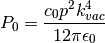
we can use it to define the normed powerdistribution

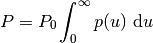
With known powerdistribution  the total power emitted by a dipole emitter within a planar stack is therefore
(1)
This powerdistribution is shown in Figure 4 of [FW84] although it is named  and the normed transverse wavevector is named
  .
.
Configuration
LIGHTPILE explicitly calculates the powerdistribution of a single dipole emitter with the dipolestudy task. It requires information about the wavelength, frequency or energy of the dipole (spectralpoint) and the range of the transverse wavevector (angularrange).
[dipolestudy]
spectralpoint wavelength nm 633
angularrange u None 0.1 1e4 1000 log
The wavelength of  is equivalent to the given energy of
  .
.
The result data is presented in text form and as a graph.
The graph of the powerdistribution  versus angular data is named
 graph_p_a and can be configured in the section [graph_p_a] in the configfile:
[graph_p_a]
yscale log     # format: yscale <log|linear>
lines all      # format: lines <all|total>
xlim 0.1 1e4   # format: xlim <xlim_left> <xlim_right>
ylim 1e-2 1e4  # format: ylim <ylim_bottom> <ylim_top>
# format: externaldata <path_to_datapoint_file> [label]
externaldata "examples/ex_ford1984/ford1984_fig4a.dat" "Ford d=0.05nm"
Results
Finishing the calculation LIGHTPILE will write its output to the current working directory (the one from where LIGHTPILE was called).
The dipolestudy task produces four outputs:
- textfile
dipolestudy_data_p.txt - textfile
dipolestudy_data_f.txt - image
dipolestudy_graph_p.png - image
dipolestudy_graph_f.png
The textfiles include all the data used to generate the graphs. Additionally important parameters and not visualized results are included. The format should allow an easy import into other data manipulation or visualization programs.
We will shortly discuss the angular powerdistribution result . The emission propability  is discussed in section Powerdensity vs emission propability density.
Running LIGHTPILE twice for both emitter distances  we get graphs as shown in Figure~ref{fig:fig4}.
The blue line represents the total powerdensity emitted .
Also shown are the individual contributions from vertically or horizontally oriented dipoles for both polarizations.
As our simulation contains a vertical dipole only, the total is identical to the slash-dotted red
we get graphs as shown in Figure~ref{fig:fig4}.
The blue line represents the total powerdensity emitted .
Also shown are the individual contributions from vertically or horizontally oriented dipoles for both polarizations.
As our simulation contains a vertical dipole only, the total is identical to the slash-dotted red  .
With the command :samp`externaldata` we imported and overlayed the data from [FW84] as black line.
The calculated and imported data matches up to a small offset.
This is because we do not have access to the numeric data of [FW84] but had to rely on graphical extraction which introduces systematic and random errors.
.
With the command :samp`externaldata` we imported and overlayed the data from [FW84] as black line.
The calculated and imported data matches up to a small offset.
This is because we do not have access to the numeric data of [FW84] but had to rely on graphical extraction which introduces systematic and random errors.
Let us now discuss the plot of : Different ranges of the normed transversal wavevector are associated with different kind of modes.
For  the power is emitted as radiative modes with emission angles in air of
  up to
up to  .
Modes with
.
Modes with  are bound to the planar stack in different ways.
In our case of a free emitter in front of a metallic interface we do not have any waveguide modes.
The peak at
are bound to the planar stack in different ways.
In our case of a free emitter in front of a metallic interface we do not have any waveguide modes.
The peak at  is associated with the excitation of a surface plasmon-polariton mode at the silver-air interface.
The emitted power is transported along the silver surface and dissipated due to losses in the metal although these losses are not required for the existance of the plasmon mode.
The very broad and high exitation beyond
is associated with the excitation of a surface plasmon-polariton mode at the silver-air interface.
The emitted power is transported along the silver surface and dissipated due to losses in the metal although these losses are not required for the existance of the plasmon mode.
The very broad and high exitation beyond  is due to dissipation effects in the metal and can be attributed to lossy surface waves.
As discussed in [FW84] the model of complex refractive indexes as a local response of the material to electromagnetic excitation is becoming less usefull for highly evanescent waves and not valid in the range of  .
Nevertheless we see LIGHTPILE correctly calculating the powerdistribution within the local model.
To stay within the range of the local model emitters should be placed at distances
.
Nevertheless we see LIGHTPILE correctly calculating the powerdistribution within the local model.
To stay within the range of the local model emitters should be placed at distances  of metal interfaces.
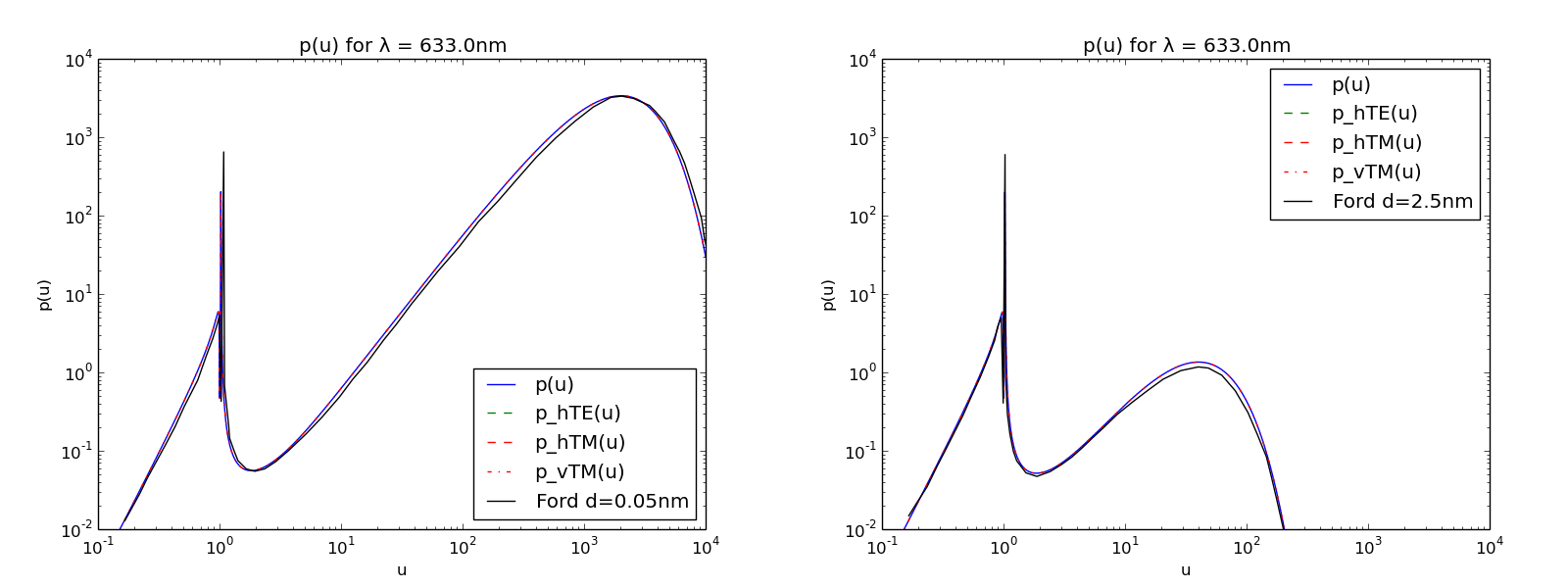
Powerdistribution for different emitter distances
for a vertically oriented dipole emitter above a silver interface as described in [FW84]. The black lines represent the graphically extracted data of [FW84]. The limited accuracy of graphical extraction explains the slight offset to the LIGHTPILE caluclated lines. Only TM polarized radiation is seen as a vertical dipole does not emit TE polarized radiation.Powerdensity vs emission propability density
In this section we are going to discuss the emission propability density as shown in graph_f_a or returned in the textfile dipolestudy_data_f.txt and its meaning in relation to the powerdensity .
This is important because in the field of excited emitters in thin film stacks is often more valueable as can be misleading.
Definition of emission propability density
As discussed in section Result quantities and given in (1) the total emitted power of a dipole emitter is variable, depending on which itself depends on the stack and therefore the optical environment.
That implies that a dipole antenna close to a metal surface emits more power than the same dipole antenna in free air.
This is possible because the derivation of assumes a forced oscillation of a dipole with constant amplitude.
If we use this model to simulate the decay of exitonic states, as in LEDs, OLEDs or quantum dots we have to account for important differences.
Excitonic emission is a stochastic process and it is easily understood that the total emitted power has an upper limit in the injected electric power of the electronic charge carriers.
The influence of the optical environment on the emission propability of an emitter or its rate  is known as the Purcell Effect.
An excited quantum emitter near a metallic surface does not emit more power, but its propability of emission is higher.
Its rate of radiative emission is increased while possible nonradiative decay is assumed to be unaffacted.
is known as the Purcell Effect.
An excited quantum emitter near a metallic surface does not emit more power, but its propability of emission is higher.
Its rate of radiative emission is increased while possible nonradiative decay is assumed to be unaffacted.
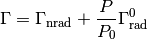
The classical dipole model is connected with the quantum picture by the assumption that the propability for photon-emission is proportional to the total emitted power of the classical dipole  .
.
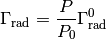
With the inclusion of nonradiative decays with the rate  , assumed to be independent of the optical environment, the total decay rate
and the effective radiative quantum yield
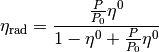
is obtained.
The only unknown parameter is the emitter dependent intrinsic radiative quantum yield  or intrinsic quantum efficiency IQE.
We define the emission propability density  as
as
(2)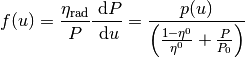
so that  .
.
Discussion
In the definition of in (2) we can see that it differs from only by a norming factor.
This norming factor  expresses the difference of a constant amplitude emitter and a stochastic quantum emitter.
Let us compare the two cases of [FW84] with emitter distances of and .
We are interested in the brightness of the two emitters as seen from any angle in the air halfspace and use Fig. comparison of for different emitter distances with shown in blue and shown in black.
Due to the extreme coupling of evanescent waves to the lossy surfacce modes in the case of small distances of the emitter to the metal the integral  is increased dramatically.
 for the case
  (left) while only
  in the case of
  (right).
In the picture of constant amplitude dipoles the former would bear a huge strain on its external power supply but appearing with equal brightness compared to the later for an external observer.
This is expressed by being equal in the radiative mode range (
(right).
In the picture of constant amplitude dipoles the former would bear a huge strain on its external power supply but appearing with equal brightness compared to the later for an external observer.
This is expressed by being equal in the radiative mode range ( ).
If we compare the observation of two ensembles of exitonic emitters excited by a constant supply of charge carriers there would be a difference of around five magnitudes for an external observer as can be seen by the dramatically reduced emission propability density .
).
If we compare the observation of two ensembles of exitonic emitters excited by a constant supply of charge carriers there would be a difference of around five magnitudes for an external observer as can be seen by the dramatically reduced emission propability density .
It should be noted that is much easier to calculate than . To determine the norming factor needed for we have to calculate at every positive to find the integral  . As this job can never be truely accomplish we have to rely on reasonably good estimates.
We should keep in mind that both quantities and have their uses but in the case of excitonic emitters the emission propability density is less misleading.
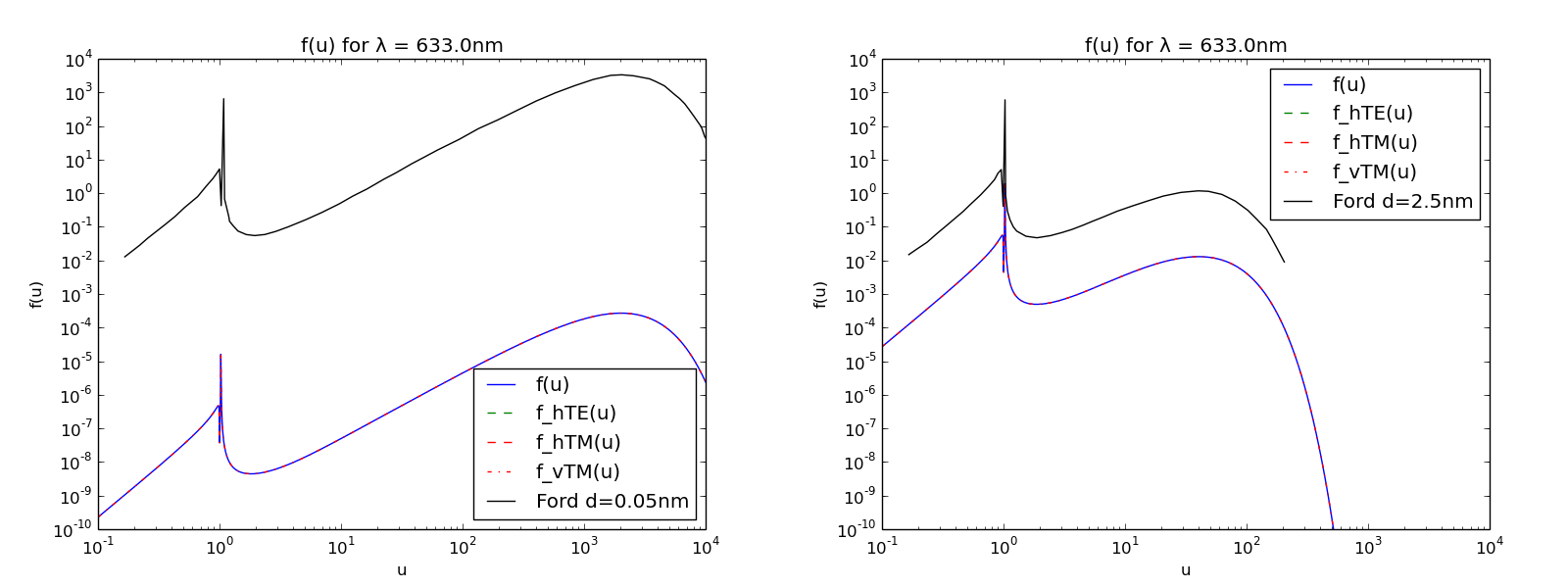
comparison of for different emitter distances
(blue line) for radiative modes () is dramatically reduced for decreased distance to the silver film (left) compared to the greater distance (right). In contrast the emitted power density (black line) is unaffected. The change in the emission propablity density shows the expected effect of quenching near metal interfaces.Footnotes
| [1] | The used dielectric constant  for the silver film is taken from Fig.11 of [FW84]. for the silver film is taken from Fig.11 of [FW84]. |
| [2] |  is the speed of light in vacuum. is the dipole moment of the dipole. is the speed of light in vacuum. is the dipole moment of the dipole.  is the wavevector. is the wavevector. |
| [FW84] | (1, 2, 3, 4, 5, 6, 7, 8, 9, 10) G W Ford and W H Weber. Electromagnetic interactions of molecules with metal surfaces. Physics Reports, 113(4):195–287, 1984. |